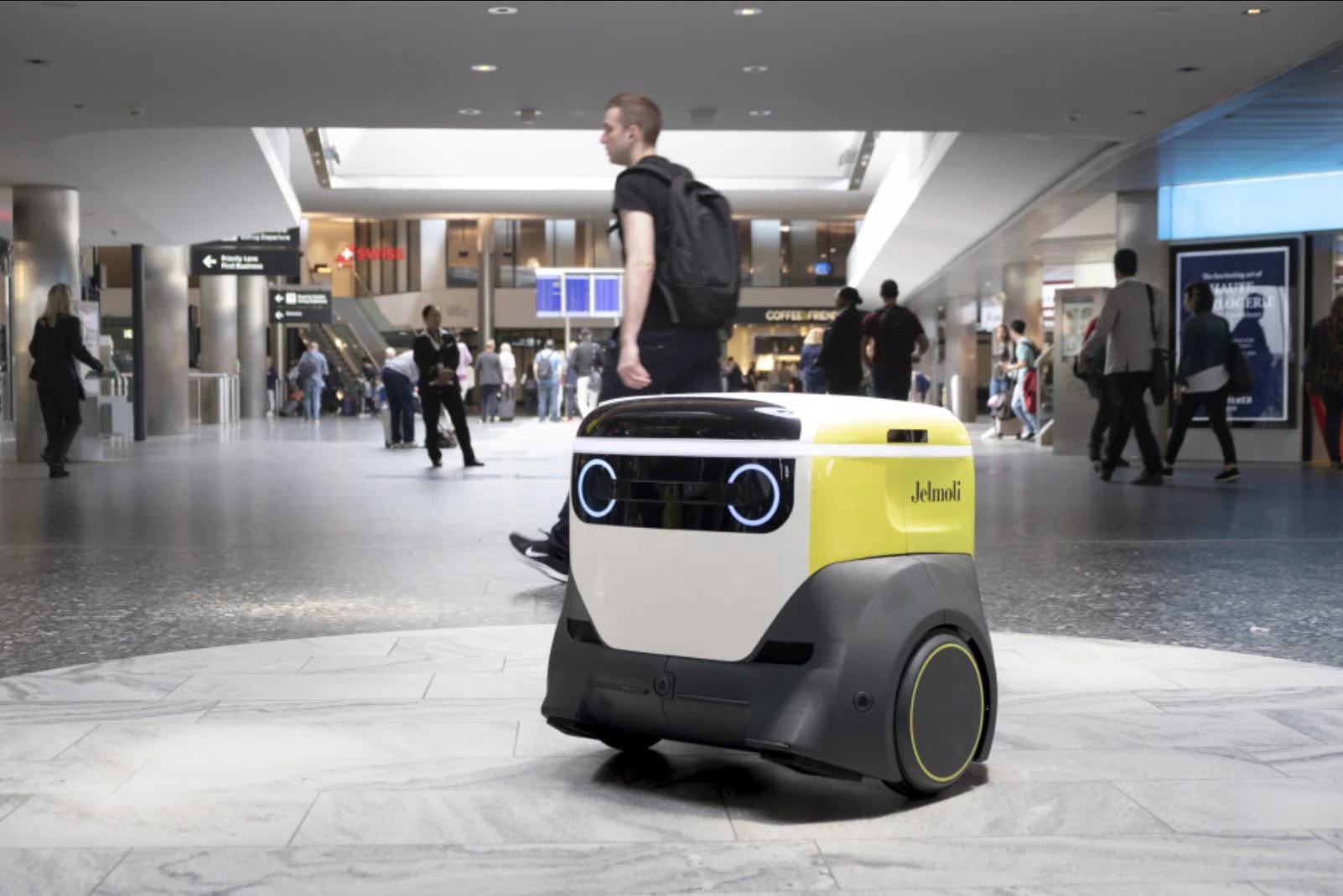
“Nobody in an airport is going to read a manual. Whatever it needs to say, it has to say by moving, lighting up and making a noise.”
The brief
Jelmoli, Switzerland's premium department store, wanted a robot that could take something bought in their online store and deliver it to a pick-up point somewhere in Zurich Airport. The target was a working prototype in the concourse in 2020. It was an ETH Zürich Focus Project, built with ZHdK, which meant an engineering team and a design team on the same machine for a year.
The engineering was the obvious hard part and it was not the part I worked on. Mine was the other one: a knee-high machine moving through a public concourse is read by hundreds of people who were told nothing about it, asked nothing about it, and will decide in about a second whether to step aside, ignore it, or follow it. Get that wrong and the navigation does not matter.
Five parties, not one user
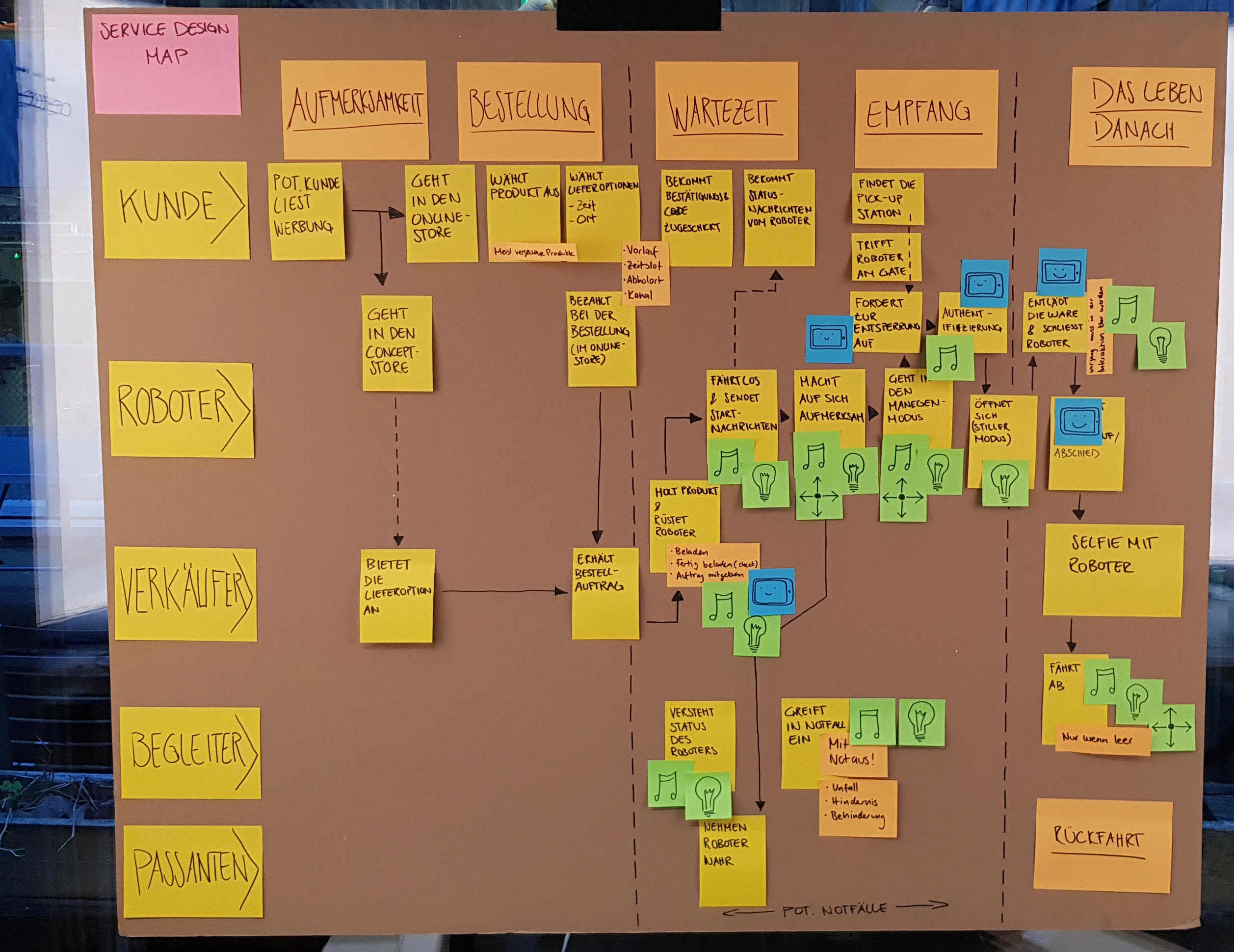
The service map is the piece of this project I would still draw the same way. The columns are the phases of a delivery: attention, order, waiting, hand-over, and what happens afterwards. The rows are everyone the robot touches: the customer, the robot itself, the salesperson, the attendant, and the passer-by who never ordered anything and is simply in the way.
That last row is the one that changed the work. A passer-by is not a user, has no stake in the delivery, and is the person most likely to be standing between the robot and where it is going. Designing only for the customer would have produced a machine that works perfectly for one person and is a nuisance to everyone else in the building.
A crate, a face, and an LED strip
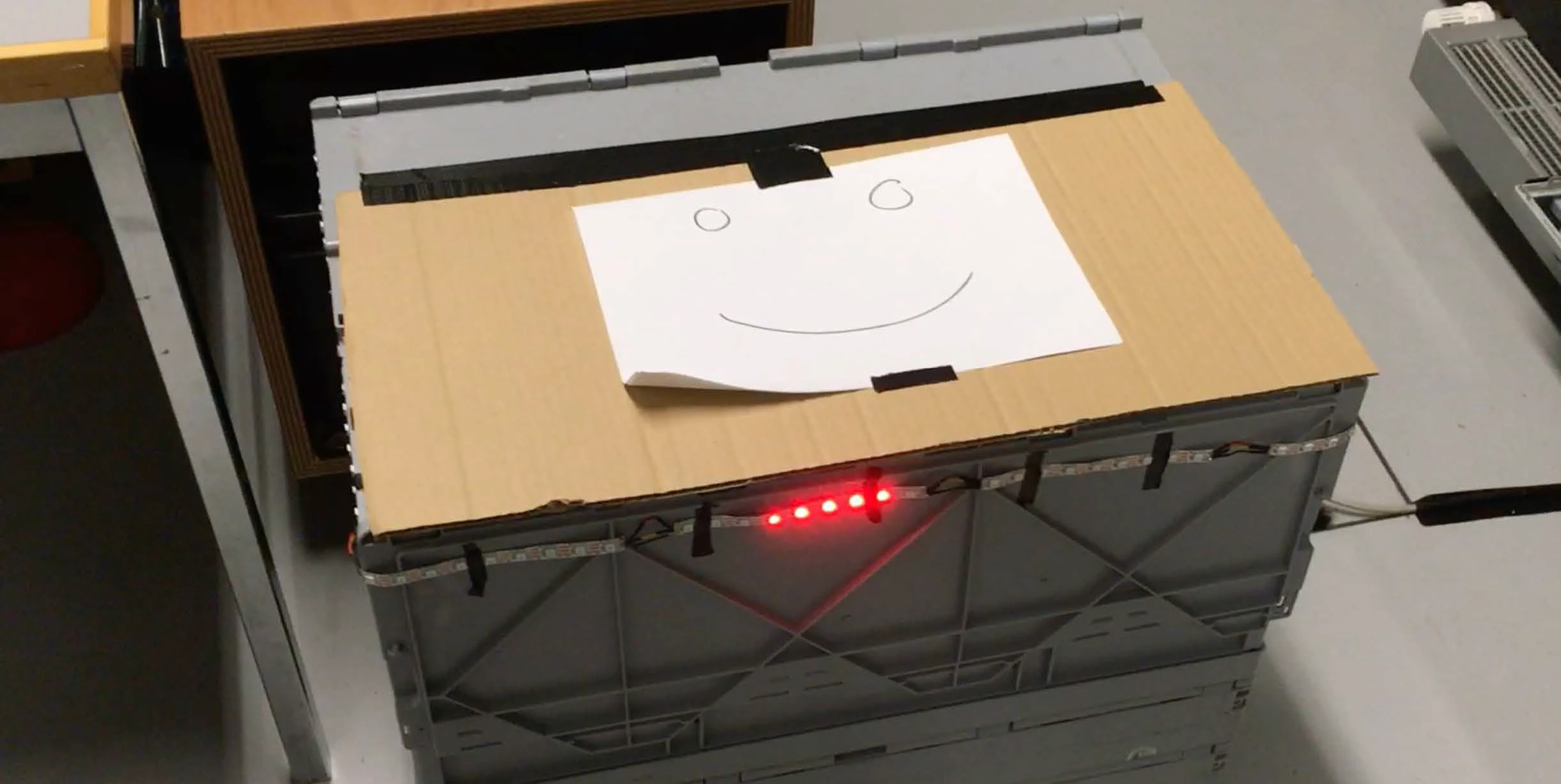
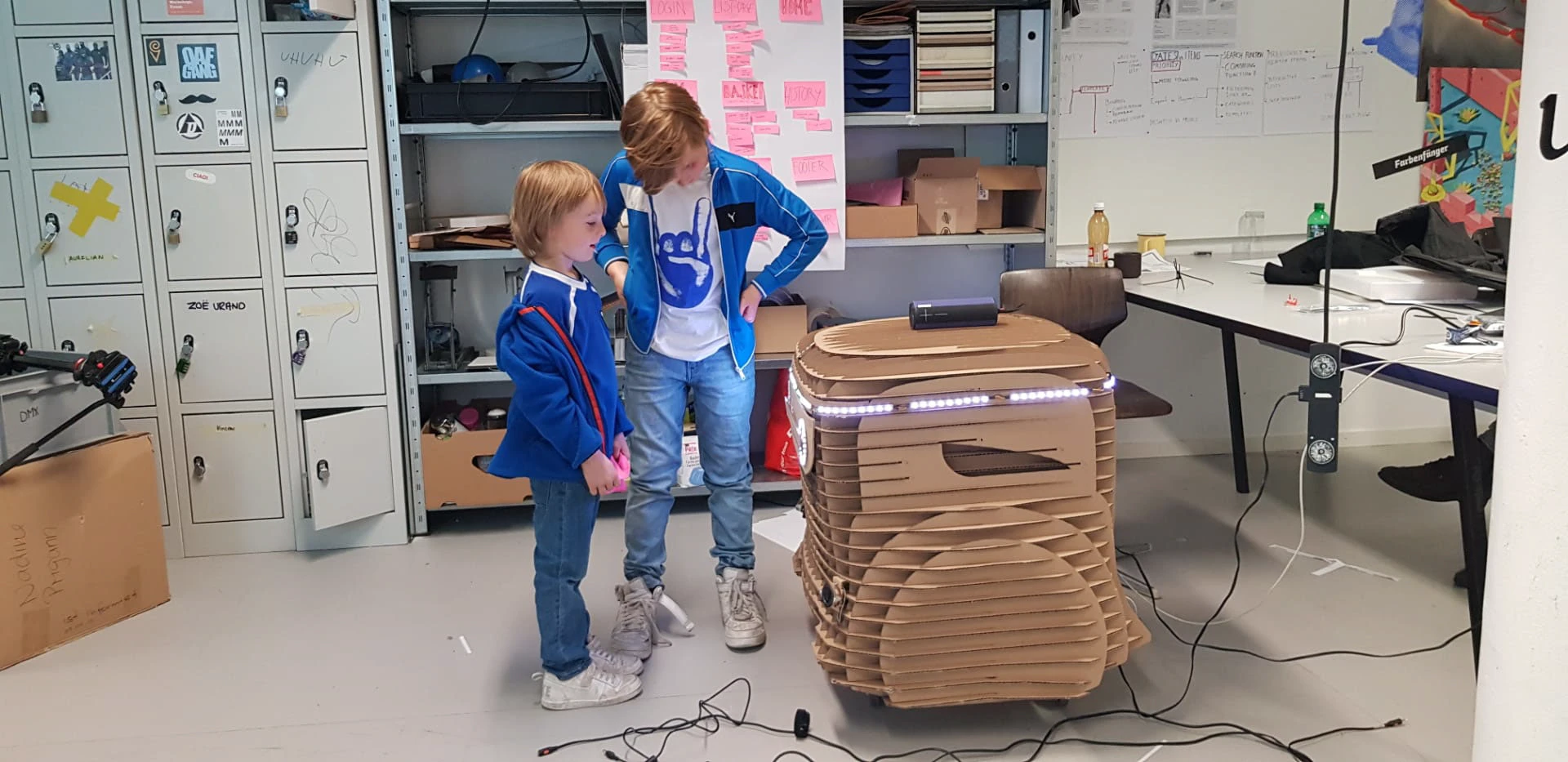
Before anything was designed we built the cheapest possible version of it: a folding crate, a cardboard lid, a sheet of paper with a smiley drawn on it, and a strip of LEDs. Then we pushed it around and watched.
The questions it was built to answer were deliberately blunt. What height reads as approachable rather than underfoot? What is the first thing people do? Should it talk back? What happens if it has a face? How do people behave with no introduction and no explanation? How do children react, and how do animals? What would anyone actually order?
A crate with a paper face answers those in an afternoon. A finished robot answers them a year too late.
Light instead of words
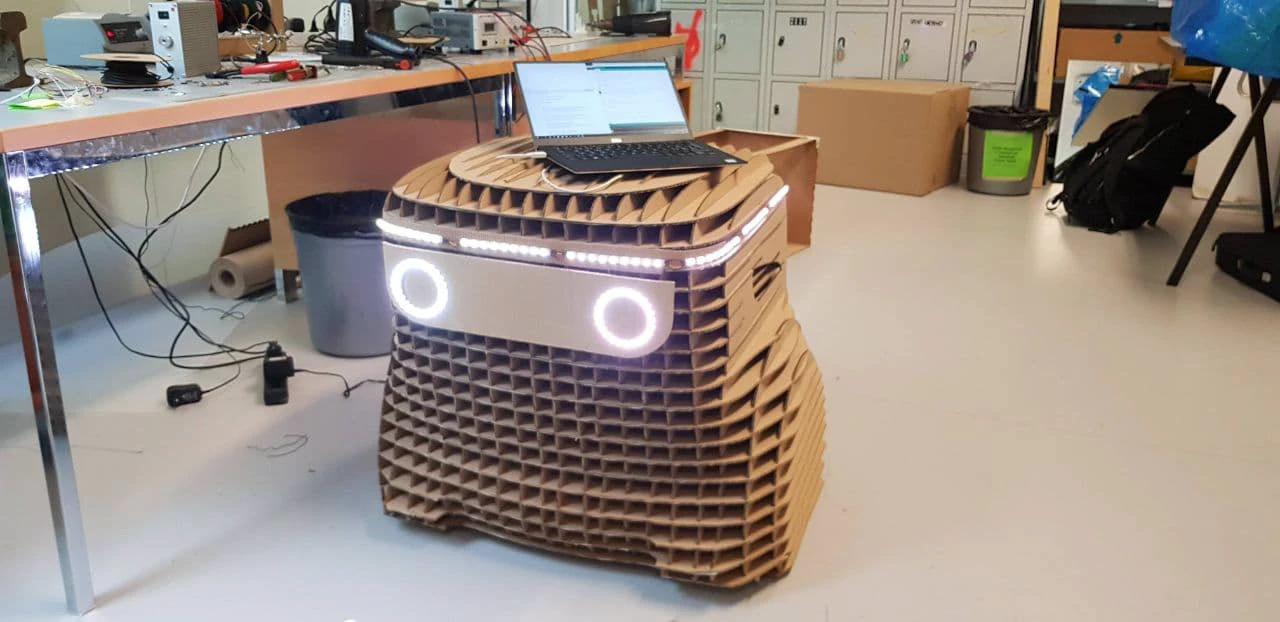
adero has no screen and no text on it. Everything it needs to communicate (that it has noticed you, that it is waiting, that it is about to move, that it has arrived) is carried by light, sound and how it moves. That constraint was not imposed on us; it came out of the crate. People did not read anything on it. They looked at the front of it and decided.
So the front of it became the work: two rings that read as eyes without being a cartoon, a light bar that changes with state, and a sound vocabulary short enough that a stranger learns it by watching one delivery.
The people who never read the manual
The best testers were children. They approach without hesitation, they touch it, they stand in front of it to see what it does, and they have no idea what it is supposed to be, which is exactly the position every passer-by in an airport is in, minus the confidence.
If a ten-year-old works out what the robot is doing from the lights alone, an adult in a hurry will too. If they cannot, no amount of documentation is going to save it in a concourse.
The part you actually touch
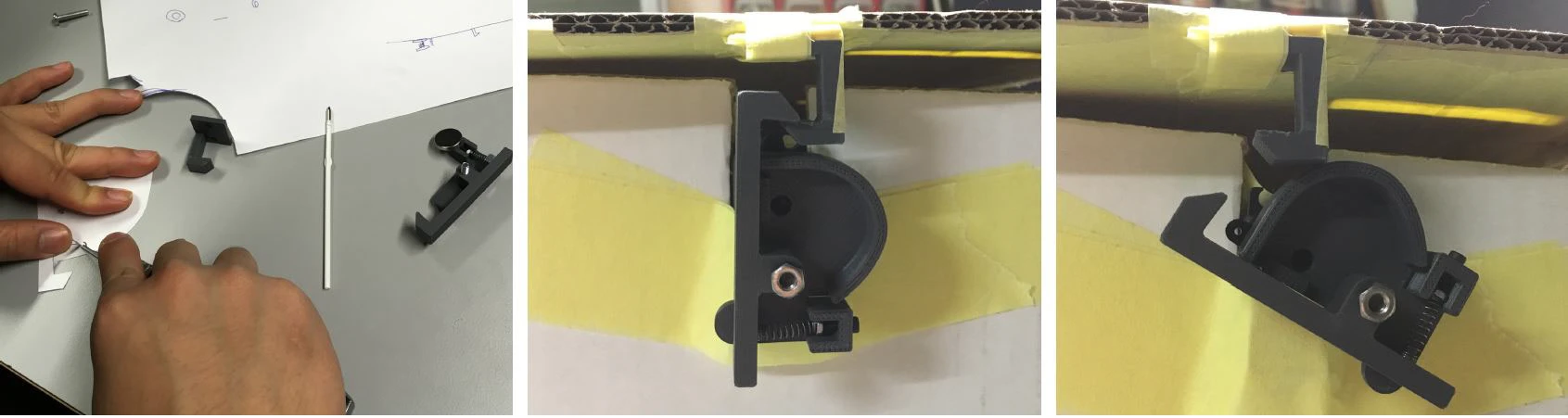
One interaction is physical: the lid. It is the only moment a customer has their hands on the machine, so it had to open in a way that needed no instruction and could not be got wrong, and survive being operated by strangers all day.
That meant prototyping the mechanism itself rather than specifying it: hinge geometry in card and tape first, then printed parts, then the version that went into the build.
Outcome
14
students across two schools, engineering and design, on one machine
5
parties the service map had to satisfy at once, the passer-by among them
0
words on the robot: everything it says, it says in light, sound and movement
It was built, and it ran in the concourse at Zurich Airport with Jelmoli's name on the side. What I took from it has outlasted the robot: that the person who did not ask for your product is still one of its users, and that a crate with a paper face taped to it will answer questions no amount of specification will.
Credits
- Focus Project team
- Mirco Grob, Marcial Koch, Seth Weber, Kiran Doshi, Franziska Eckert, Kira Erb, Lucien Erdin, Philipp Honegger, Frederic Letsch, Grzegorz Malczyk, Nico Schulthess, Andri Simeon, Andreas Voigt